I had two hours to activate a park with my Ten Tec Scout 555…
When you don’t have much time, but you want to POTA, what do you do?
I happened to be in a local community near Buck’s Pocket State Park for two separate events but there was about 4 hours between them. Armed with this knowledge I looked at the POTA map and found this was only 30 minutes from where I started and 30 minutes from the second event. This left me with about 2 1/2 to 3 hours to activate! Plenty of time to net a new-to-me park! So I was off!
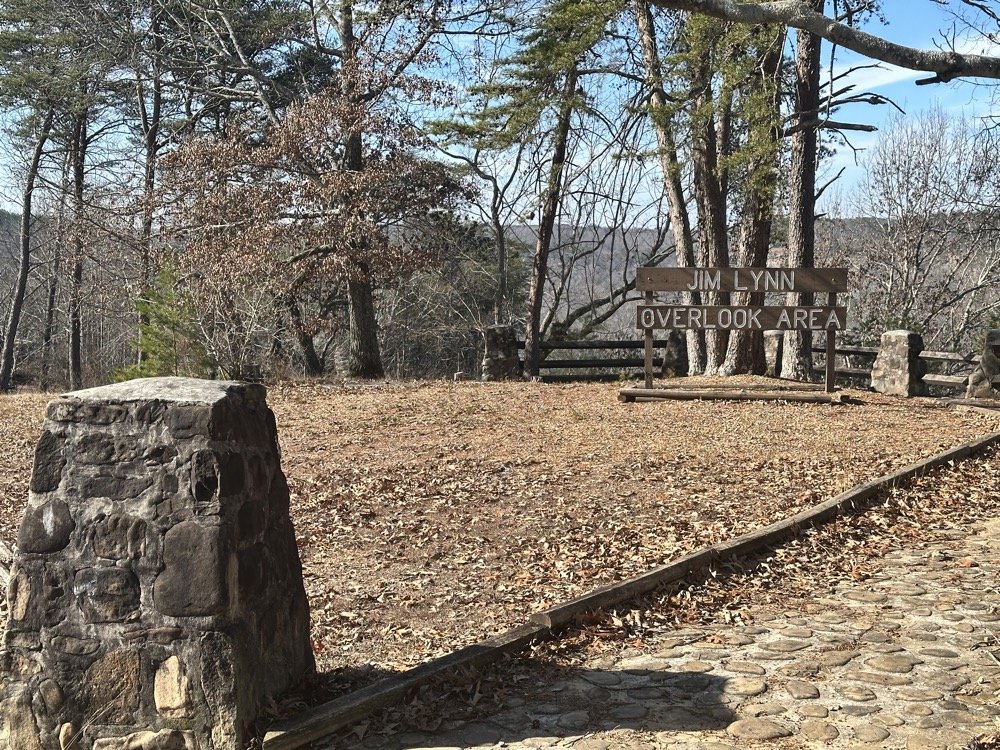
After following my map for a while I came across this sign and had to stop for a quick photo. I didn’t even get out of the truck, just rolled down the window and grabbed the image and headed off. The spot I chose for the activation was an overlook on the other side of the park. So I had to drive through the whole park to get to the overlook. Bucks Pocket is a canyon in the side of Sand mountain running down to the Tennessee river to the west. The river in the bottom of the pocket was dry on this day so it was not even worth my time to stop and get a photo, besides, there was contacts to be made…
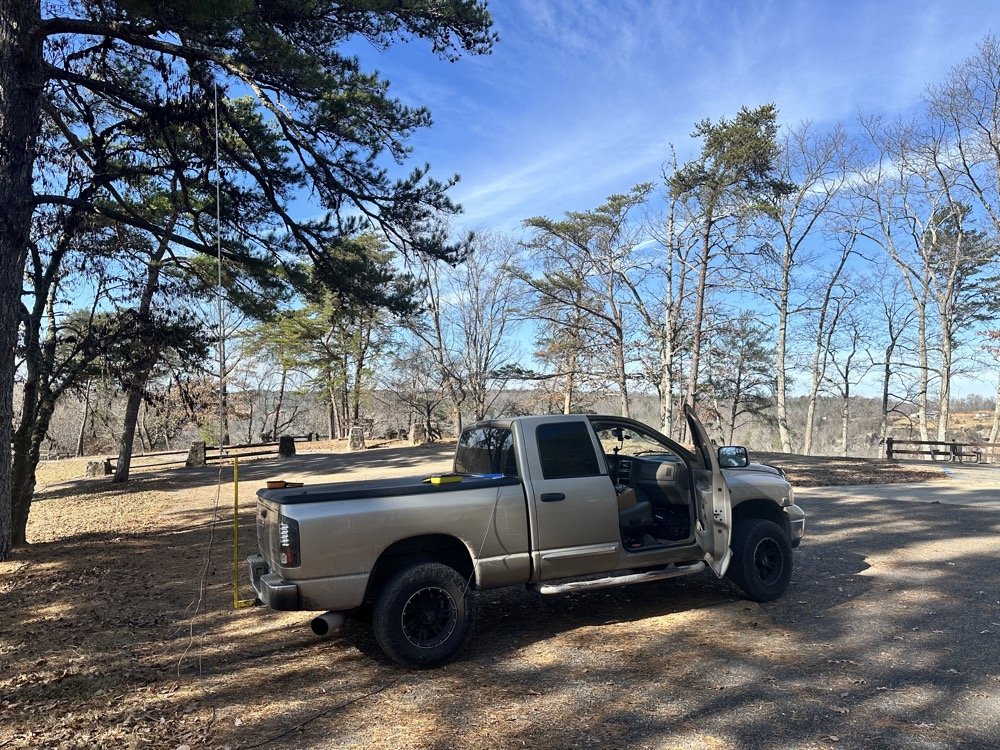
Once on the other side, I had to find a spot in the over crowded parking lot…(that was sarcasm by the way). There was literally no one there when I arrived and I got to choose a location that was convention for setting up the vertical antenna.
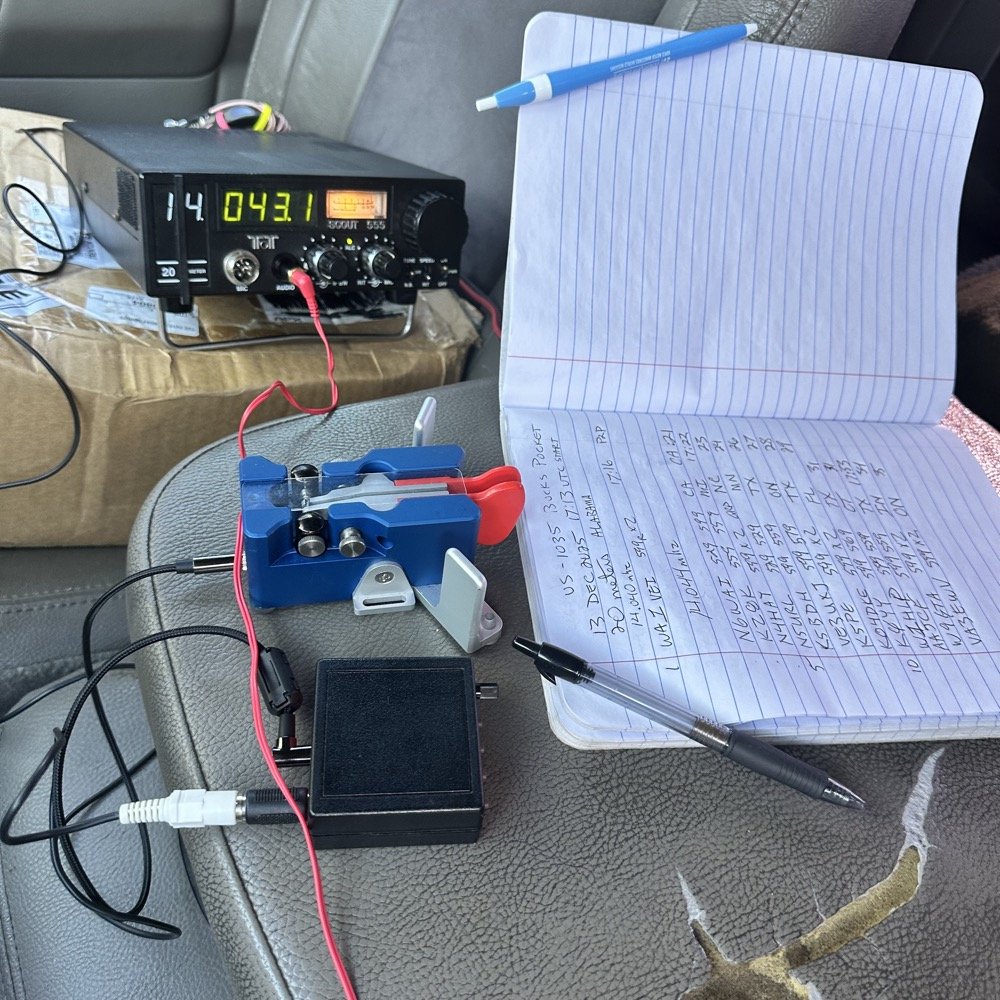
Wanting to have the best chances to get the park in the bag, I chose to start on 20 meters CW with my trusty TenTec Scout 555 that I have been using as of late. I have some maintenance to do to this radio and couple others but for the most part it is a wonderful machine. Keying was with the Begali Traver CW key. I like this key because of many features but the best one it that the feet fold up to protect the paddle when not in use. That is a really cool feature for a key that is field deployed on the regular. Once again you see the Begali feeding into the HamGadgets Picokeyer as well. Once I found these little keyers, I have not looked back, they just work so well…and Ten Tec radios from the OG days don’t have memory keyers in them either. I really found Bucks Pocket to be a nice place that was radio quiet as well as ambient noise quiet for the most part. You would get an occasional hiker or two that would pass through, but I had the place to myself for the most part.
Operating the Ten Tec Scout 555 is really a breeze too. These don’t use encoders to tune them. I don’t know why they chose to build these radios like this either. The design could be due to durability concerns as these were marketed as mobile radios, either way, these are tuned with a PTO and not a VFO. A PTO is a Permeability Tuned Oscillator which means you are screwing a ferrite slug into a huge inductor with the big knob on the front. Due to this mechanical operation, the tuning knob doesn’t “free spin” like modern encoder tuned radios. You have to turn it by hand the whole time to get it to move. It is also VERY analog, meaning that the frequency will not be precise but rather…kinda close to the final value. It doesn’t even display anything past the “hundreds” position and for good reason, it isn’t needed. I tune by ear with this machine, well and a little background knowledge of the radio. These are honestly made for SSB, that is what all the engineering is done around, BUT this being Ten Tec, they simply couldn’t leave CW out of such a cool radio. So they weaseled their pet mode into the rig anyway. If you will look on the front, you wont see a mode switch to change it from CW to SSB. This is because the geniuses at Ten Tec figured out that CW is simply SSB with a tone and not words. So if you want to use CW, you have to push the frequency off by the 700hz side tone opposite of what the side band is for that HF band. So 40,60,80 and 160 are all shifted up 700hz (roughly) to be on frequency and 30 through 10 meters are all shifted down 700hz. Easy once you do it a couple of times.
So easy in fact that the radio only has 5 knobs and three switches. Volume (AF Gain), IF BW (This is the amazing Jones Filter of legend), RIT and Mic Gain, the PTO and if your rig has the Noise Blanker module installed the first switch will engage the NB if pushed down and up is the tune mode where the radio transmits with about 15 watts forward power to allow adjustment of a manual tuner. The middle switch has the keyer speed control if switched up (more on this in a minute) and down engages the RIT function, the last switch is the ON/OFF power switch to turn the radio on and off. On the back is a switch to change the meter from SWR to forward power measurement and some ports to plug all your goodies in to make it work…you know, like antennas, keys, power cables and such.
This little portable radio has a built in CW keyer, I am pretty sure it is the Curtis keyer chip of legend as the internal keyer does work very well. But it has two caveats, the first is that it has no memories so you hammer out all the code you want to send, the second it that on the back of the radio is two key ports. The first key port is for a dual lever paddle and this is what the switch on the front works with. When you throw the switch to the “Speed” position a number is displayed representing the internal keyer speed at the time. (This is always 25 WPM upon EVERY power up cycle.) and you can change it by pressing the left and right paddles to increment with one paddle and decrement with the other paddle. Once the keyer speed is to your liking, throw the switch back to OFF and the keyer speed is set…till you power off the radio and then it will reset to 25 WPM again. The other port right below the paddle port is the straight key port. This is where I plug in the Picokeyer as it acts as a straight key on the output. The simplicity of these radios are what make me love them so much. If I could have one change, it would be that I could trade the “tune” with a switch that would switch the AF Gain knob over to RF Gain so I could have both of those controls. RF Gain is a wonderful thing in many conditions. Alas, I cant have it all I guess so I live with the radio like it is for now.
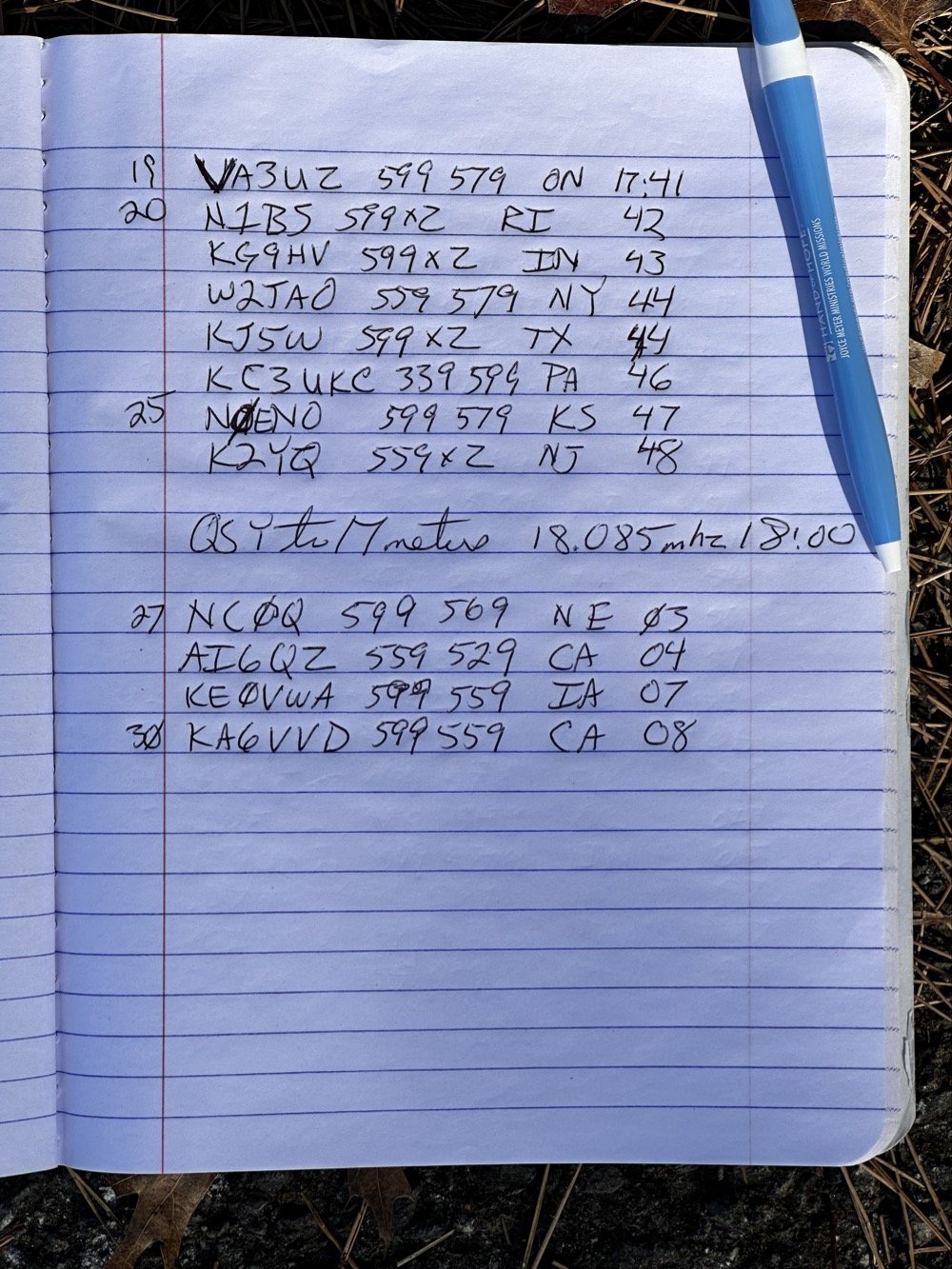
All that aside, I started on 20 meters like I said earlier and had a great run of contacts of 26 QSOs in as many minutes. This has to be some sort of record for me or something, but it is awesome to have runs like this when your activating a park. The worst nightmare for an activator is to get to the park, setup all the gear and no one answers his calls. This was quite the opposite and I was stoked to have bagged the activation so easily. Then I wanted to move up to 17 meters to see what I could scare up since I had the activation secured, I felt more comfortable venturing off of 20 meters…
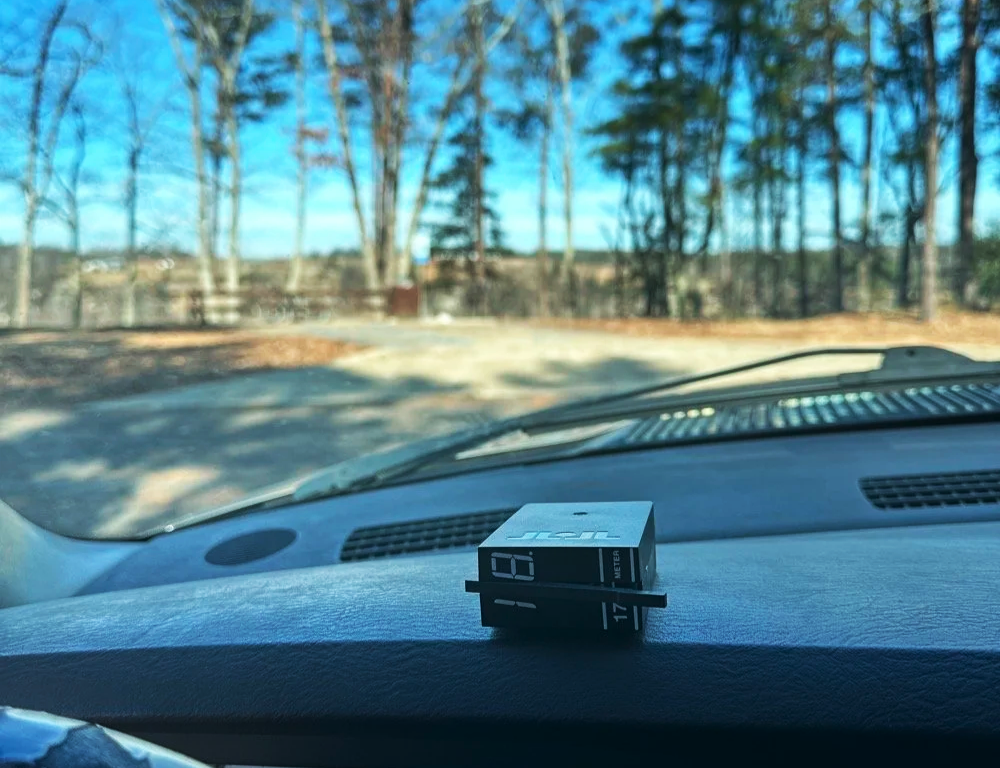
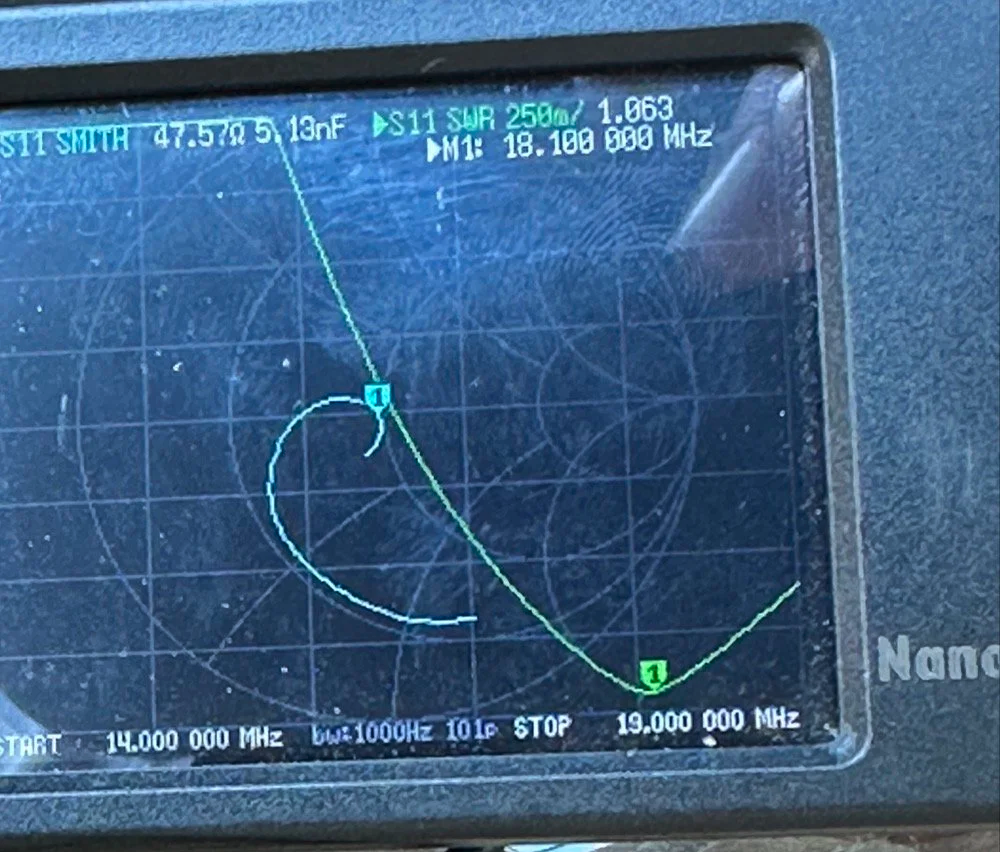
But first I had to re-tune the antenna which meant getting out the nanoVNA and going outside for a few minutes. This photo of the nanoVNA just goes to show how good a vertical is with some radials for a return path of the RF. The 2:1 SWR plot is over 2mhz wide for the 17 meter band. and if I had messed with it more, I am sure I could have improved it further, but this is almost no reflected power already so I was happy enough to pop in the 17 meter module and juice up the Scout.
To give you some perspective, the SWR meter on the Scout moved to the rest position when I keyer the transmitter… This was as good as it gets. I can hear you antenna nerds already in the comments section, “ a dummy load has perfect SWR too” and yes, your right, this is different though. This is a tuned antenna system so the RF has somewhere to go instead of making heat. There are no transformers or termination resistors, just coax, a radiator and some radials. I just adjust the radials and the vertical till they show what you see above on the smith chart. 13nF capacitive could probably be fixed by moving the radials a little more closer to vertical below the antenna, but like I said, it was just not worth the squeeze at this point so I hopped in the truck and got back on the air. These antennas just plain work. Just look at the logbook for proof.
Well, 17 meters was … 17 meters. I dialed up the FT8 area and it was alive with activity. I then dialed down to the bottom of the band and came back up slowly and found just a couple of stations on the band. Undeterred, I found a clear frequency, listened for a bit, called QRL with no response then started calling CQ.
Over the next 10 minutes or so, I worked 4 stations and two of those were California! The band was open to the west coast…too bad all the hams are on the east coast… haha. I still had a great time on 17 meters though, there is something about this band that draws me to it. I think I like the less crowded bands like the WARC bands. It was a surprise when I would get a reply too, which is different from 40, 20 and 15 meters a lot of the time. After I worked what I could I was about out of time and needed to pack up anyway so I wouldn’t be late and I wanted a few minutes to take in the views as well. This is a really nice little park and is an easy activation too.
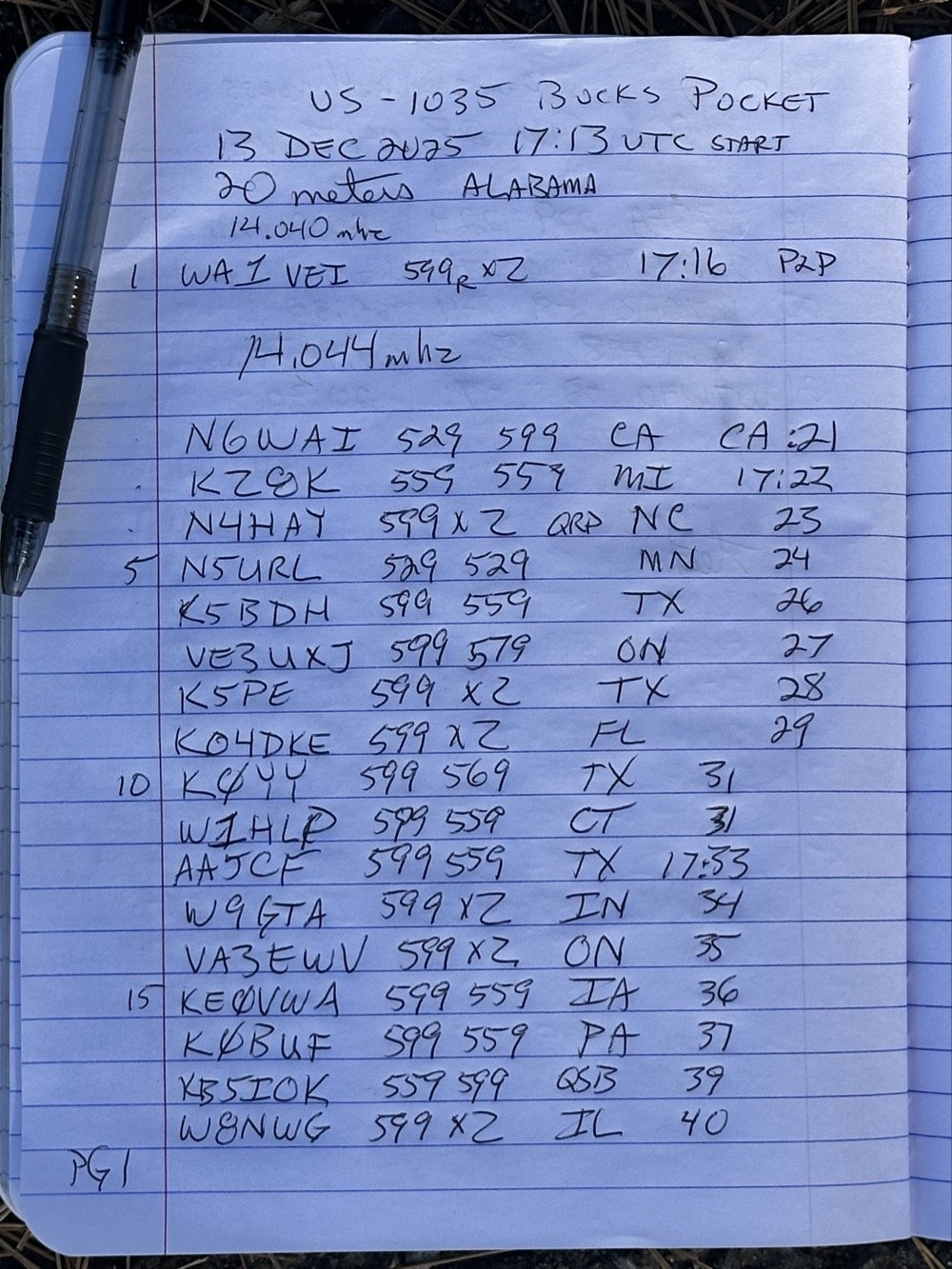
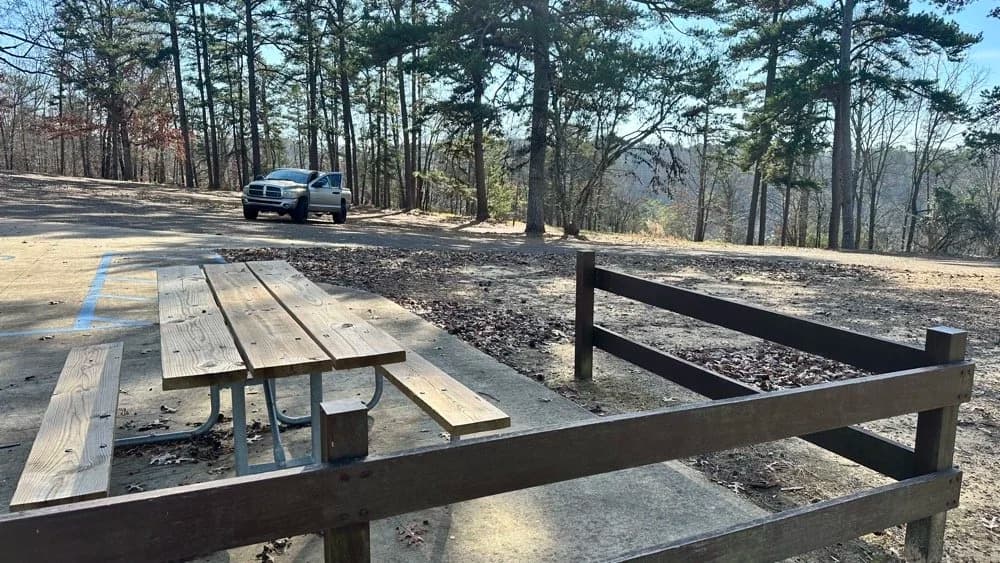
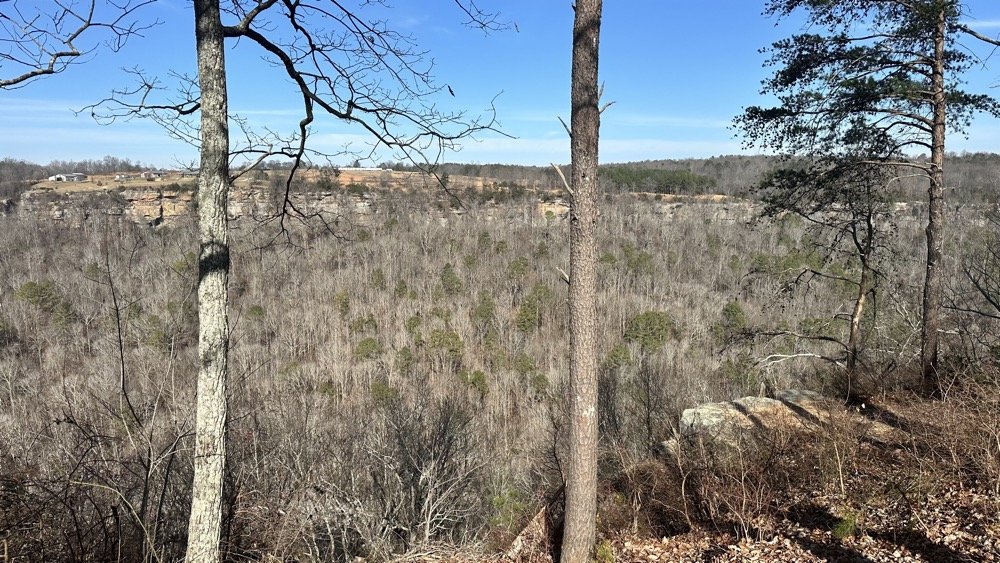
Getting 30 calls in the log while enjoying a view like this is what POTA is all about. To get you out of the house and into the world a little and I love it. IF you see your name in the log below and want a QSL card from me, just mail me a card and I will be happy to reply with one.

73
WK4DS