POTA Antenna Creativity at US-9880
As I sit here and write this, I can’t help but think that there is a segment of amateurs that would have never attempted what I am about to describe as it would be unthinkable to them. These are the hams that I hope read this article as I want them to see that you are not bound by your commercially available gear and you can improvise and it will probably work with a little knowledge and creativity.
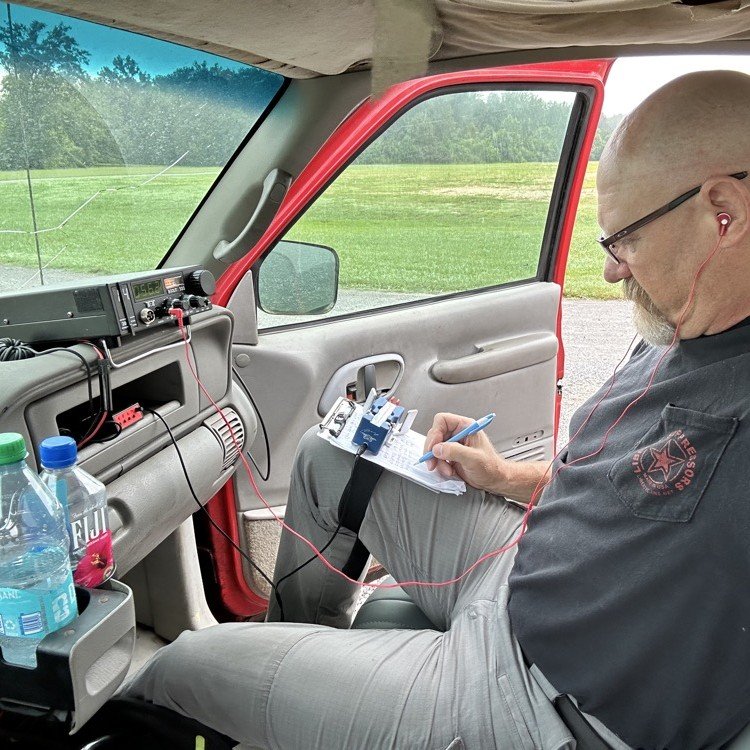
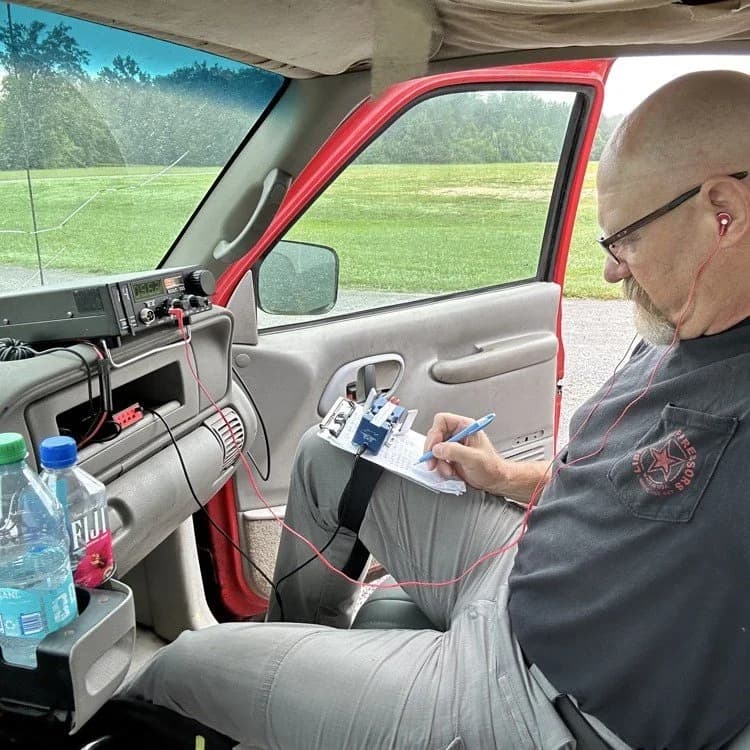
Today I went to Stevenson Alabama and their city park sits within the Crow Creek Nature Refuge which happens to be a POTA park. It is US-9880 and is an easy drive to the water’s edge from the main road. I picked a spot and started setting up the system. I ran the TenTec Scout 555 again today and also used the Wolf River Coils 213” whip antenna along with the receiver mount I built and a bunch of ground radials as you can see in the photo above. The great thing about the whip is that it is telescoping so to tune it, you simply extend or collapse sections till the null on the nanoVNA is close to where you want to operate and then tinker with the radials to get the SWR to a reasonable level. I seem to be getting about 63 ohms of impedance at the base of the antenna like this so it works well with my Wireman coax to connect the radio. This whip is just long enough to get me to the 20 meter band when tuned like you see above and that gains me access to all the others up to 10 meters because of it. (Well 6 would work too but I don’t have a radio to get on 6 meters so I don’t include it).
Today saw me start out on 20 meters because of this and I was able to get 22 calls in the log on 20 meters before deciding to move up to 17 meters because of someone calling CQ on top of me. I no longer let this bother me as a lot of people can’t hear me at a park, but I can hear them. Since figuring this out, I give grace to someone who starts calling CQ on the same frequency and simply spin the dial and find a new spot to setup.
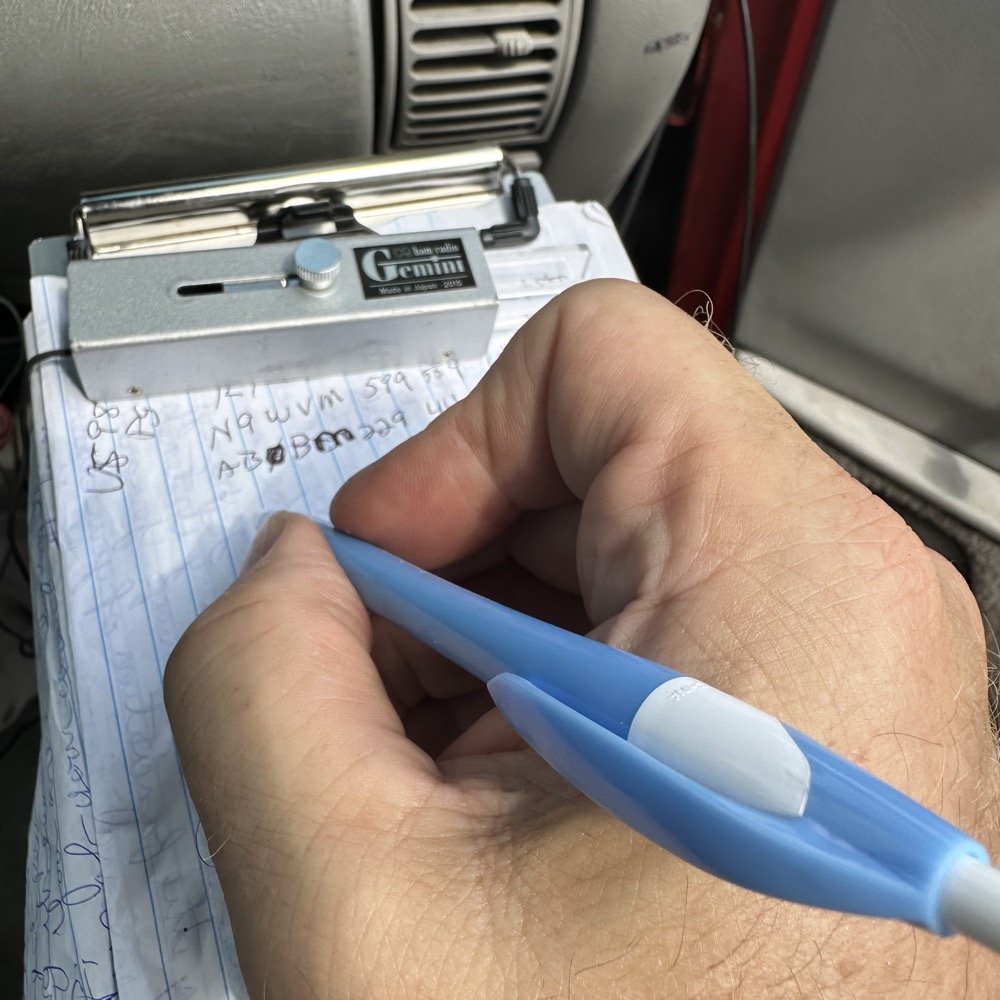
I also FORGOT MY COMPUTER to log with…uggg. This means I had to make an impromptu log book out of some old scrap papers I had in my “possibles tote” that I take everywhere and use the flight leg board for a table. As you can see in this photo, I was still using the Begali Traveler at this point. This key is nice as long as you have somewhere to sit it down, it is not a good hand held key so I put it away and got out my Gemini travel key and used it for the rest of the day. This IS the perfect key for this type of setup in my opinion.
The bands were fading pretty hard this morning and I had to fight with them to get several calls into the log. As you can see above, I had to correct AB0BM a couple of times to get it right before completing the exchange. Shoot I received my first 009 signal report today from NE0NS in Illinois on 40 meters… But part of that could have been my antenna.
Speaking of my antenna… and wanting to get on 40 meters, did I mention that this whip will only tune down to 20 meters when fully extended? Well, that seems to only be a suggestion when it comes to cobbling junk together, as you are about to see, I was able to get this antenna to work on 40 meters today just fine.
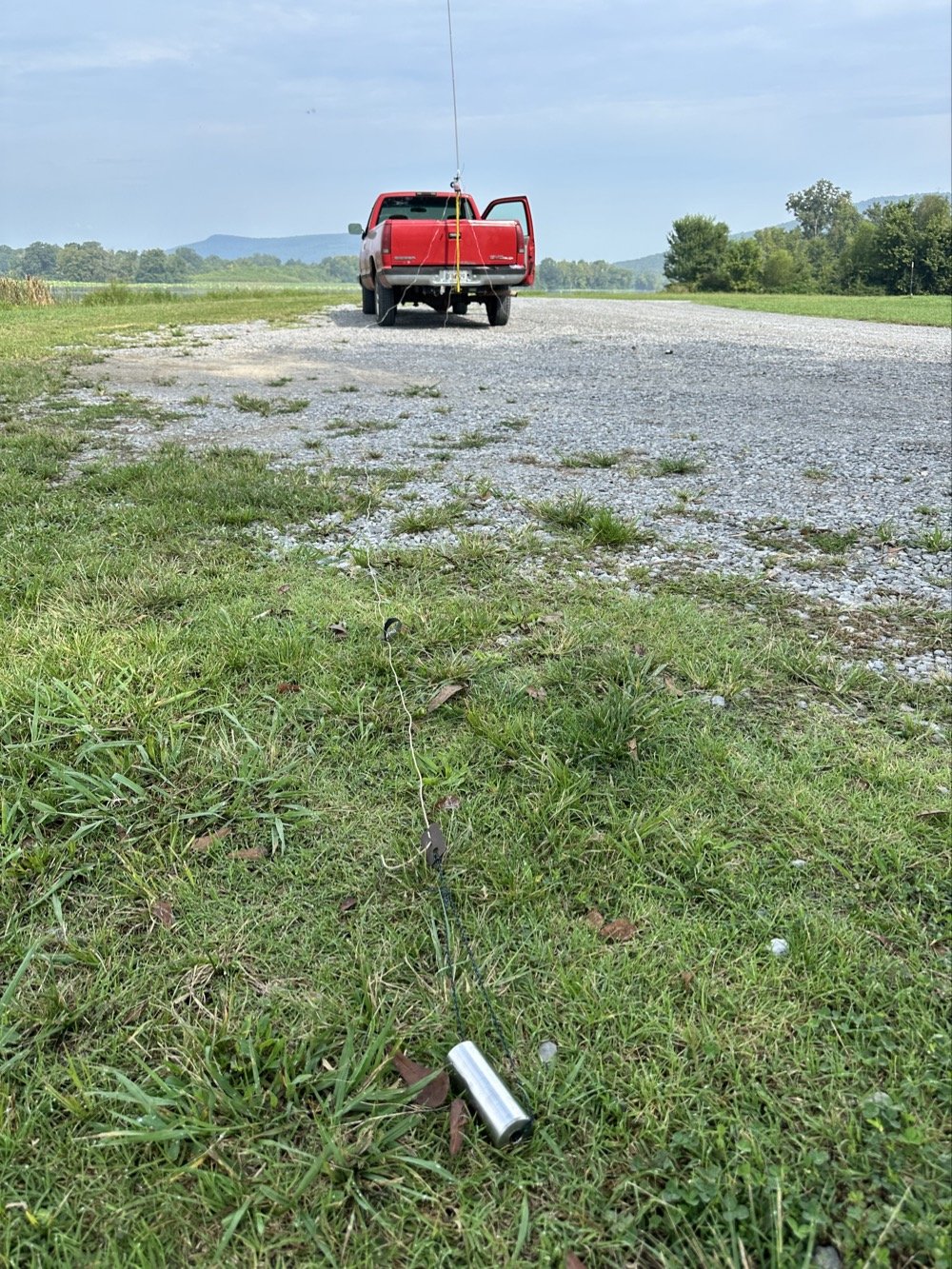
I started with a really long radial which was actually my 40 meter radial set (normally connected at the center) ran full length out to a weight in the grass. The radial is over 30’ long like this. By the time I had taken this photo, I had “tuned” the antenna which includes moving the radial around to adjust impedance on the system. That is why it is not taught in the photo below.
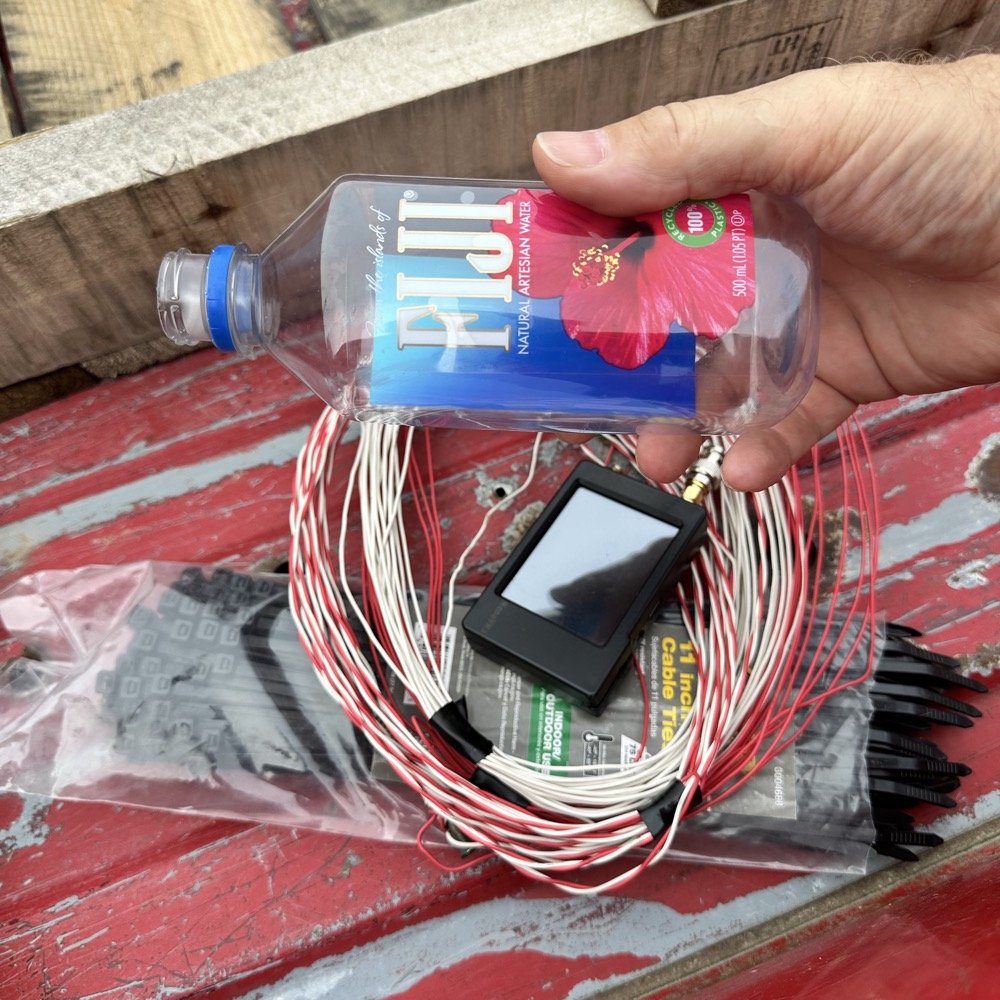
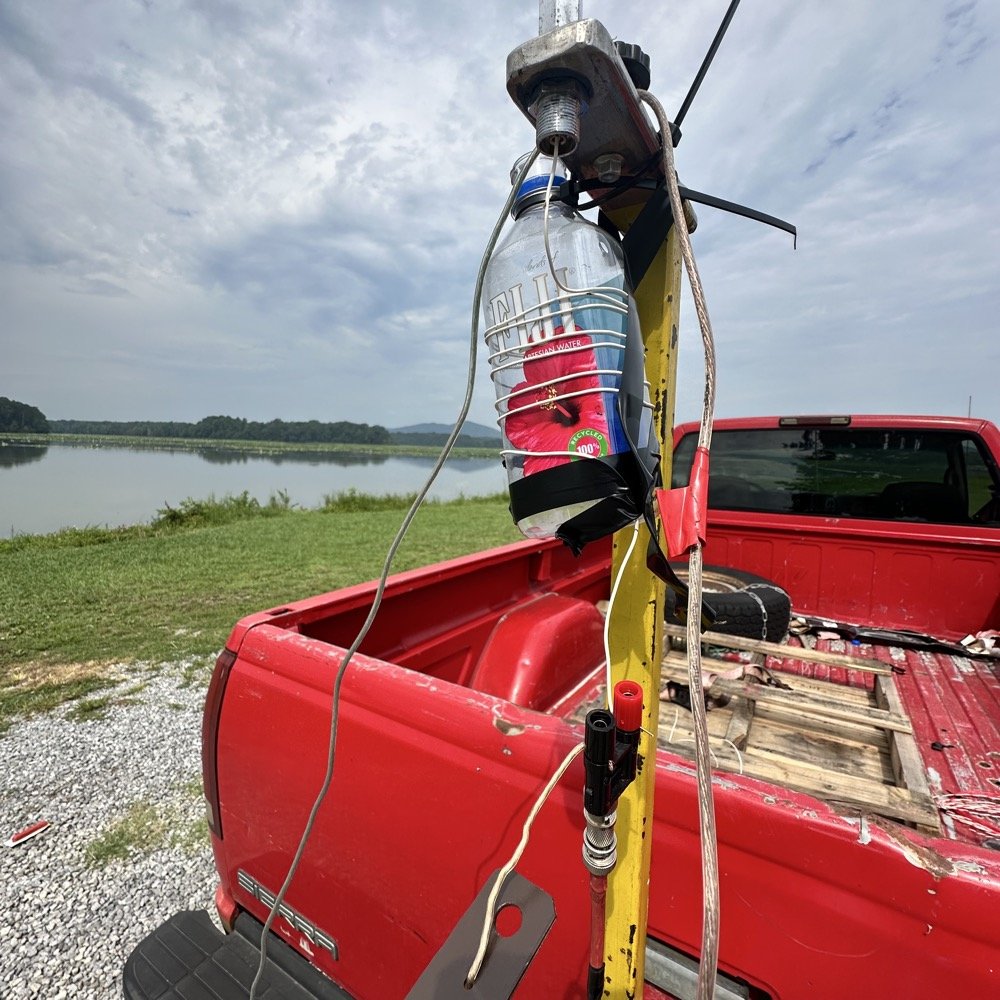
The next thing I had to do what figure out how to make the antenna at least “appear” longer to the radio so I could trick it into thinking it was really a 40 meter resonant antenna. I gathered some supplies as you can see below and started cobbling together a load coil to put at the base of the antenna. As you can see I had the nanoVNA ( a critical part of this side project), I also rounded up a roll of electrical tape before I was done, to hold the coil together. The wire is from the 10$ antenna video I did recently on our YouTube channel and I keep zip ties in the truck all the time. All I needed past this was a coil form and I found it with this used water bottle I had in the truck.
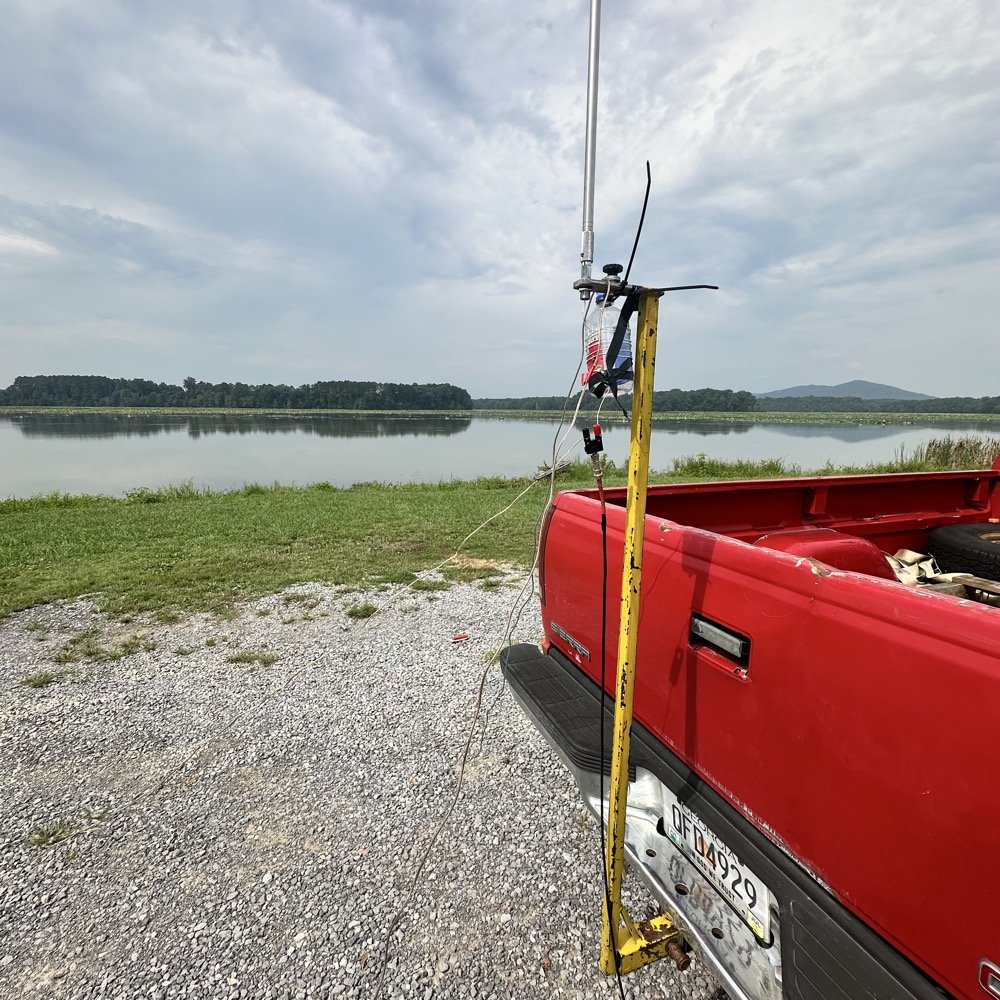
I will be honest with you here. The next photos show what I ended up with and not what I started with. I actually started with too much wire. So much that it was actually resonant on 80 meters instead. I had a nice deep null on 3855mhz when I first got it on the air… not ideal for nearly 11:00AM local time operation. So I started removing coils and checking and removing coils and checking… I removed WAY more than I thought I would need to actually, but I think this is because I was using such a large radial field compared to what companies like Wolf River Coils plans on you using. I had the two 13’ radials and that one long 30’+ radial all run out together so there was a massive ground plane at work here.
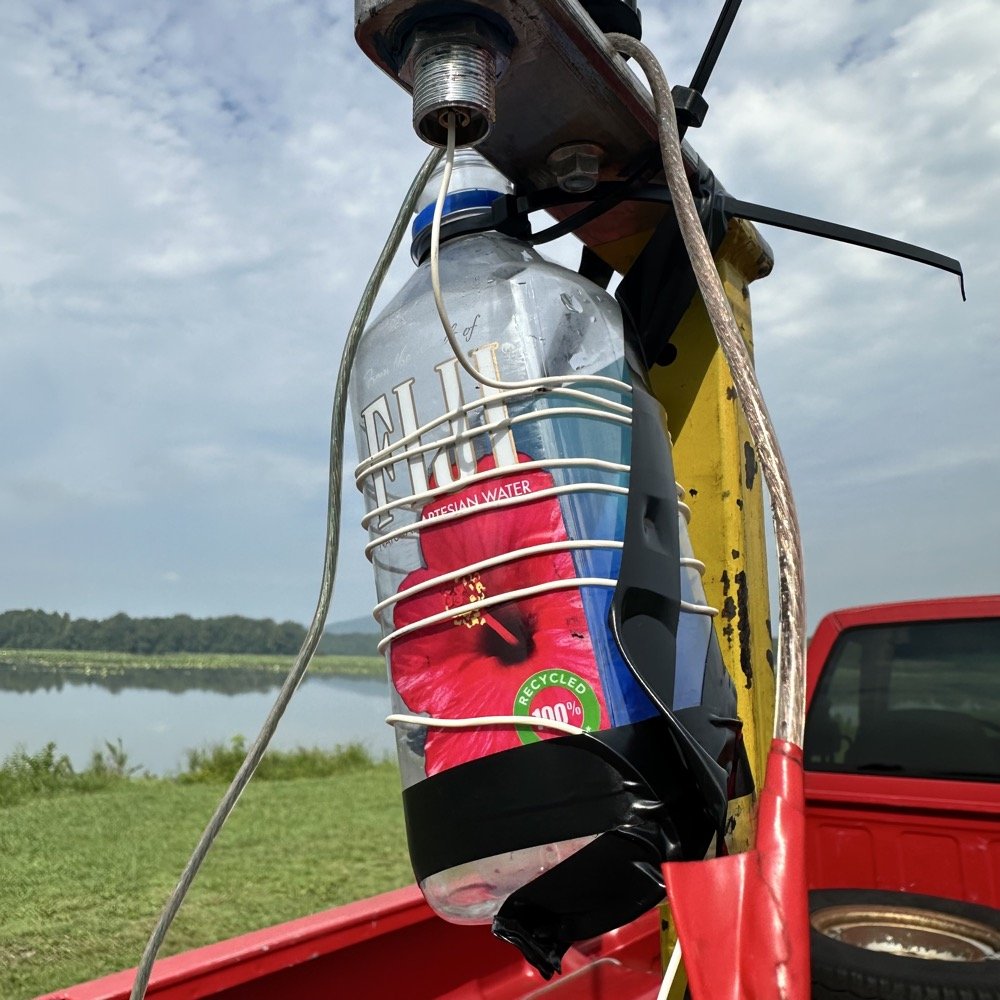
It took some creativity to get it all connected to be honest. I had to go through all the adapters in the nanoVNA kit and use some other devices like you see here with the BNC to banana plug adapter so I could couple it to the coax. I had to do this so I could gain access to the base socket of the vertical whip. I needed to connect the coil the the base of this part of the antenna to get the system to be electrically correct.
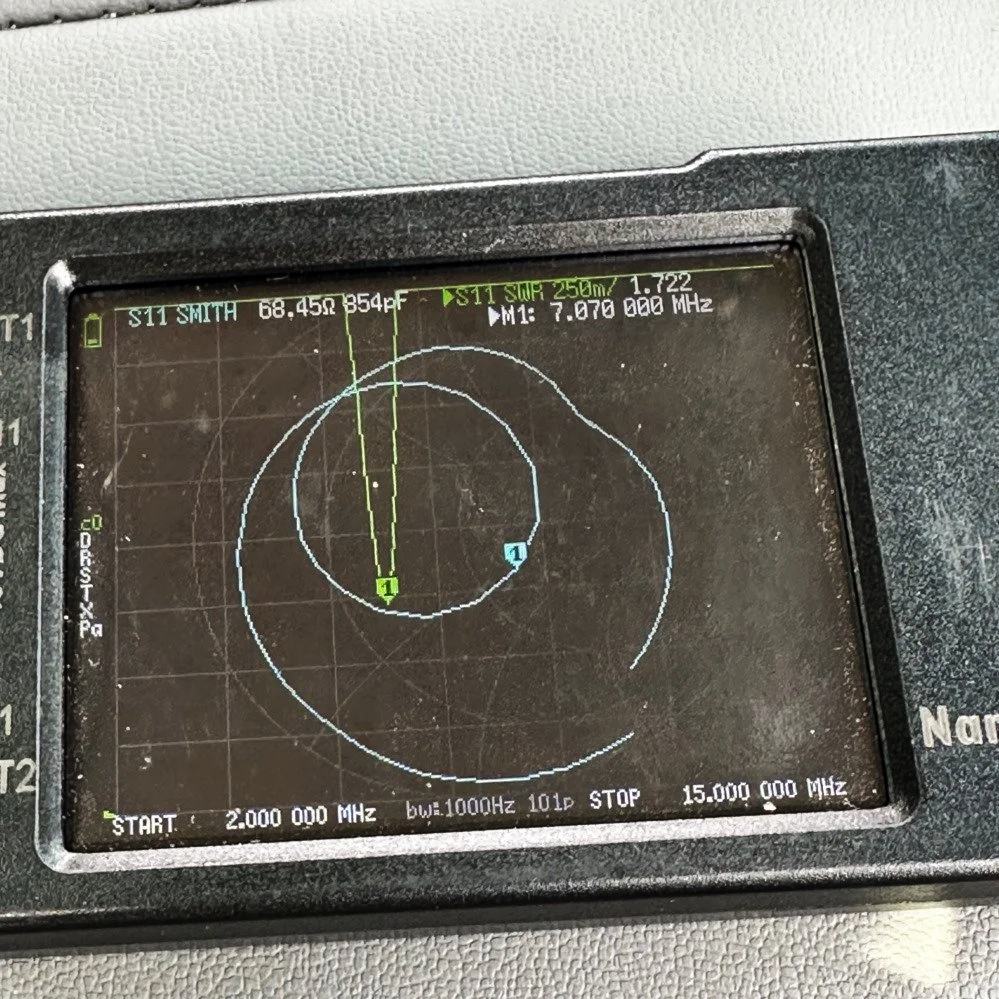
The wire from the load coil is simply stripped bare and folded over to make a “spring” like pin to stick up into the base socket of the vertical whip. This actually worked better than I thought it would. I simply kept removing coils from the water bottle form till I got close, then I started spreading them out to move the frequency up into the 40 meter band space. I think when they were compressed together they were resonant at about 6.55mhz or so. I could tell it was working but I didn’t want to cut too much and have to start over so I went pretty slow to get to this point. This landed me on 7.070mhz just like I wanted as you can see below. Notice as well that you can see the SWR plot is 1.722:1 which is completely usable in my book.
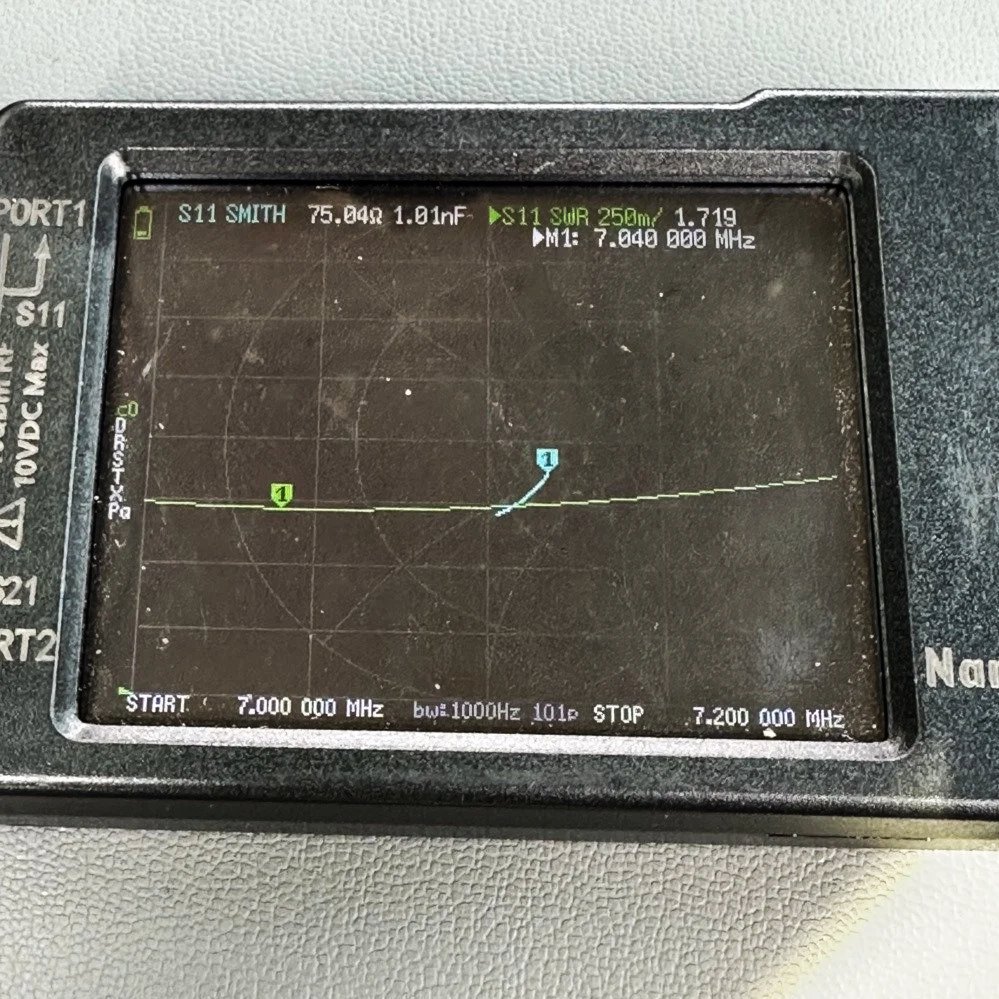
The bandwidth covered the whole CW segment of the 40 meter band as well as you can see in this photo below. To say that I was happy would be an understatement at this point.
Armed with this knowledge and confidence that I was not going to fry my radio output transistors, I hopped on the air to see what I could hear. Well… stations were booming in! Success!
Next I did a little hunting and found KJ9X on 7.060mhz and gave him a call. Got a 549 back from him and I was off to the races! Now to find a clear frequency and set up shop. I finally settled on 7.048 and got started. I never had a huge pileup occur, which is a good thing in my book, but I did have times when there were three or four stations calling at once.
A little word of advice here, don’t zero beat my signal. I will get two stations that are zero beat and if they are calling together I will only get garbled information as the two signals sound identical and will blend perfectly. Push off 10 or 20 hertz and I can hear your signal over the cacophony of sound that is coming in. Trust me this works.
I was able to work 16 stations with this antenna. So the next time your antenna wont tune to a band outside of the usual, don’t just give up. Take stock of what you have available and if there is enough pieces to the puzzle, you just might be able to make something work. I could see the band fading in an out in the signal reports in the log. Strong reports getting weaker then stronger again as I look down the roll. Kinda neat to see that too.
Just looking at the mess below would make you think there is no way this would work at all. The reason it does is that RF energy doesn’t play by the same rules (it really does but I like the euphemism) and can work with all sorts of oddities around it. It just needed to see what appears to be a longer antenna than what was physically there and this little home made coil on a water bottle fit the bill. I am not sure what the two shorter radials were contributing to be honest as I forgot to connect the ground plane to the black connector on the BNC to banana device. They probably acted like capacitors to ground as they would be capacitively coupled to the vertical at the base and would couple to the load coil since they are running right by it. This is speculation on my part because how in the world would you model this menagerie? HAHA!


Once I finished up on 40 meters I grabbed a couple of photos of the lake and packed up the gear to head home. It was a great day and I had a great time playing with my radio… what more could you want?
73
WK4DS